Monthly Jobs Report

Payrolls rose by 64,000 in November after falling by 105,000 in October, delayed jobs numbers show

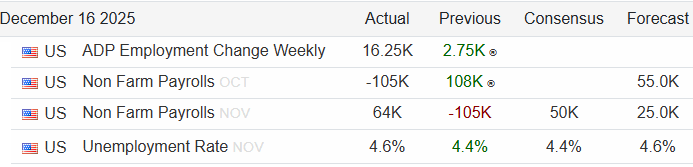
Nonfarm payrolls growth totaled a seasonally adjusted 64,000 for the month, better than the Dow Jones estimate of 45,000 and up from a sharp decline of 105,000 in October.

The unemployment rate rose to 4.6%, more than expected, and its highest level since September 2021. A more encompassing rate swelled to 8.7%.

The establishment numbers showed most of the gains in November came from a familiar source — health care added 46,000 jobs, accounting for more than 70% of the total net increase.

Markets continued to put low odds on another interest rate cut in January.


US job growth totaled 64K in November, compared with a 105K loss in October and market expectations of a 50K increase. Employment rose in health care and construction in November, while federal government continued to lose jobs. In November, health care added 46K jobs and construction 28K jobs. Employment in social assistance continued to trend up as well (+18K). On the other hand, employment fell in transportation and warehousing (-18K). Also, federal government lost 6K jobs in November and 162K jobs in October reflecting the departure of federal workers who accepted deferred buyouts as part of Trump’s push to shrink the size of government. The change in total nonfarm payroll employment for August was revised down by 22,000, from -4,000 to -26,000, and the change for September was revised down by 11,000, from +119,000 to +108,000. source: U.S. Bureau of Labor Statistics

tsp-121625b.gif
 
U.S. payrolls rose 50,000 in December, less than expected; unemployment rate falls to 4.4%

Nonfarm payrolls rose a seasonally adjusted 50,000 in December, lower than the downwardly revised 56,000 in November and short of the Dow Jones estimate for 73,000.

The unemployment rate fell to 4.4%, compared to the forecast for 4.5%. A more encompassing measure that includes discouraged workers and the underemployed dropped to 8.4%.

Average hourly earnings rose 0.3% for the month, in line with the forecast, although the annual increase of 3.8% was 0.2 percentage point higher than expected.

 
January Nonfarm Payrolls

Highlights

  • For the month of January, the indicators—payrolls, unemployment rate, average hourly earnings, and average workweek—all contained positive surprises.
Key Factors
  • January nonfarm payrolls increased by 130,000 (Briefing.com consensus: 68,000). The 3-month average for total nonfarm payrolls increased to 73,000 from -17,000. December nonfarm payrolls revised to 48,000 from 50,000. November nonfarm payrolls revised to 41,000 from 56,000.
  • January private sector payrolls increased by 172,000 (Briefing.com consensus: 60,000). December private sector payrolls revised to 64,000 from 37,000. November private sector payrolls revised to 72,000 from 50,000.
  • January unemployment rate was 4.3% (Briefing.com consensus: 4.4%) versus 4.4% in December. Persons unemployed for 27 weeks or more accounted for 25.0% of the unemployed versus 26.0% in December. The U6 unemployment rate, which accounts for unemployed and underemployed workers, decreased to 8.0% from 8.4% in December.
  • January average hourly earnings were up 0.4% (Briefing.com consensus: 0.3%) versus a downwardly revised 0.1% increase (from 0.3%) in December. Over the last 12 months, average hourly earnings have risen 3.7%, unchanged from the 12 months ending in December.
  • The average workweek in January was 34.3 hours (Briefing.com consensus: 34.2) versus 34.2 hours in December. The manufacturing workweek increased 0.1 hour to 40.0 hours. Factory overtime was unchanged at 2.9 hours.
  • The labor force participation rate increased to 62.5% from 62.4% in December.
  • The employment-population ratio increased to 59.8% from 59.7% in December.
Big Picture
  • The key takeaway from the report is that it is a positive sign for the U.S. growth outlook, yet it may come with the cost of foregoing an additional rate cut by the Fed, at least in the near future.

Source: https://www.briefing.com/calendars/...0211083000NonfarmPayrolls&FileName=employ.htm
 
They also showed us again, just how inaccurate the data is: April 2024 to March 2025 totals just reduced by 898,000 in this report. How come these revisions never go up?

In addition to the monthly numbers, the BLS released final benchmark revisions for the period of April 2024 to March 2025. Those numbers saw the initial counts revised lower by a total 898,000 on a seasonally adjusted basis. That was a bit lower than the 911,000 figure for the initial estimate last September but around Wall Street expectations.

 
They also showed us again, just how inaccurate the data is: April 2024 to March 2025 totals just reduced by 898,000 in this report. How come these revisions never go up?


I should report you to the site manager ;)
We don't talk about those Job Number revisions - sometimes a 90% 'revision' :p:banana:

However, (comma - and there always is a comma) it kinda appears that they still can't get viable data. I mean, November was revised from 56,000 to 41,000 - that is, a 27% reduction. What are they drinking out there... Who else can 'Orange Man Bad' fire!!!
 
Back
Top