Migration to the I-fund

TommyIV

Administrator
Staff member
Reaction score
614
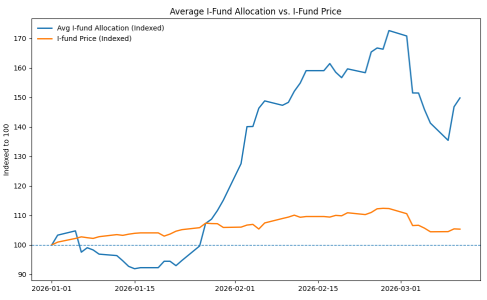
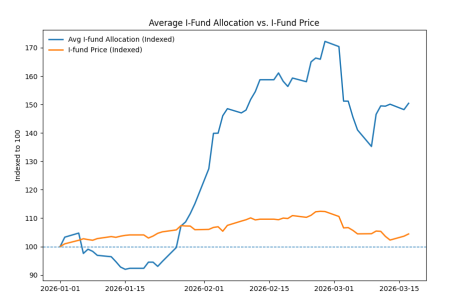
Over the past couple of weeks, the I-fund has delivered gains while the C- and S-funds have declined. In the Last Look Report, we’ve consistently watched IFTs being put to use as AutoTracker members add I-fund exposure to their TSPs.

From January 16 through yesterday, the I-fund is up 2.54%, while the C- and S-funds are down 0.29% and 2.81%, respectively.

During that stretch, 124 non-Premium AutoTracker members have made at least one IFT. Of that group, 75 increased their I-fund exposure, lifting the group’s average I-fund allocation by 27.6 percentage points.

Meanwhile, allocations to each of the other TSP funds declined on average among these 124 members. The largest reduction came from the G-fund, where allocations fell by an average of 11.2 percentage points.

It's wisely pointed out that past success does not equate to future success. But the once overlooked emerging markets fund is getting harder and harder to ignore.
 
My observations for the new 2025 I fund is that it just seems to have less volatility which can be favorable even ignoring the fact that it had a amazing year last year. Its just a unique fund that can do its own thing when the others disagree. There are additional considerations of course being an international fund but its like the I fund is finally a viable buy and hold long term investment as it covers so many bases large, mid and small caps and so many companies around the world. I will admit it is a little more tricky to time and high/low compared to the other funds from what I am a seeing. It's value and market adjustments make it more challenging to get a crazy dip buy swing for example. Overall its seems to be a really appealing fund right now where as the old I fund was never really like that.
 
It means people understand the dollar is getting weaker around the world, and it will take diversification outside the USA in order to get decent returns.
 
ACWX took a 1.65% price cut today. We'll see later what that exactly translates to for the I-fund. But I wondered how this initial trading day following the Iran conflict influenced TSP Talk investors.

It was a busy day. 35 non-premium AutoTracker members were quick to use their first IFTs of March. The S&P 500 (C-fund) and DWCPF (S-fund) were down sharply at the open but both bounced back and ended the day in positive territory.

ACWX (I-fund) however, remained stuck in the mud after the open.

Overall, the action led to a majority of the IFTs being used to decrease stock exposure and increase G-fund shares. Of the 35, 20 members increased their G-fund allocation by some degree today.

When it came to the I-fund though, the balance of inflows and outflows was a bit more balanced than expected. Of all 35 IFTs, 27 involved moves with the I-fund:
  • 14 members reduced I-fund exposure, reacting to weekend turmoil.
  • 13 members added to I-fund positions, viewing the selloff as a discount.

The average change of I-fund allocation among all 35 members was a mere -1.4 percentage points.

Get tomorrow’s Last Look Report to see which side gains momentum next.
 
The name of this thread does not apply to this week. Instead, this post will be called Migration from the I-fund.

We're about finished with our fourth day of IFTs this week, so I'm taking a quick snapshot to give us an idea of jour communities latest adjustments to their I-fund allocations.

I will be looking at the IFTs made over the last four days, excluding from AutoTracker members who are subscribers to TSP Talk Plus, Intrepid_Timer, or RevShark's TSP Timing.

Since the IFT deadline on February 27, 87 AutoTracker members have made interfund transfers. Here is how those moves affected I-fund allocations:

Change in I-fund Allocation

change.jpg

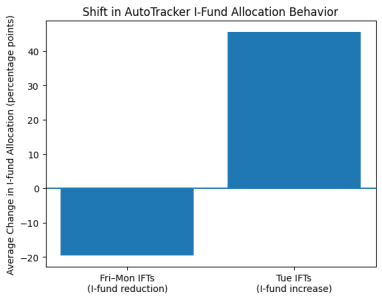
Clearly there has been an exodus from the I-fund, although a smaller group of investors has been stepping in to buy the damaged fund.

Across all 87 IFTs, the average move included a 27.7 percentage-point decrease in I-fund exposure. Meanwhile, the C-fund saw an average 1.0 percentage-point decline, and the S-fund saw an average 2.7 percentage-point decline.

Of the 87 IFTs, 51 increased G-fund allocations, with an average increase of 32.3 percentage points per IFT.

 
Back
Top