Federal Government Balance Sheet (MTS)

Boghie

Market Veteran
Reaction score
341
Reviewing the Monthly Treasury Statement (truncated at billions because millions are chump change:rolleyes:):

RevenueExpensesDeficit
FY2025 (2024/10 -> 2024/11)6271272623
FY2026 (2025/10 -> 2025/11)7401198457

Personally, I think this is more a driver for interest rates than some FED wiggle. The Federal Government is squeezing the bond/debt market with their heavy usage of credit. That will increase interest rates. We want to see Revenue go up, Expenses go down, and most importantly the borrowing (deficit) shrink. If we see interest rates hold steady or increase even when the FED decreases the base rate than things are bad. Very bad...

Another thing...
If 'Revenue' is increasing that is a trailing indicator of economic growth. You don't pay tax on loss. It could be passive gain, but that will be a minor tick. I may use this thread to document deep dive thoughts from the statement.

Finally, another last thing...
It's not really safe to take one month snapshots of the Monthly Treasury Statement. I know that sounds odd, but sometimes an expense will be paid out at the end of a month when it is normally disbursed at the beginning of the month, so... To see patterns look for anomalies. Group like(ish) months. Look at last year's revenue and spending patterns.
 
RevenueExpensesDeficit
FY2025 (2024/10 -> 2024/11)6271272623
FY2026 (2025/10 -> 2025/11)7401198457
Differential+ 113 Billion- 74 Billion- 166 Billion

I hope I can change the initial post with current data.

What this is showing - from 30k feet - is that folks are paying taxes. That is, individuals and businesses are earning more income this year than last year. That is a good thing. It will be reflected in C/S.

Another thing this is showing is that we are spending $37 Billion less per month. Kinda chump change, but...
 
I will go out to dinner a few more times a month. 😄
Mathed out and we are talking about something around $400 Billion per year, so there is that...

I think it is the DOGE cuts for the most part, so the spending decrease is structural...

Personally, whatever the FED does is meh. This deficit is the elephant in the room. 'Orange Man Bad' is not really a tight wad deficit hawk, but I don't think he wants to be the dude with the label 'I was the first President to default on the debt'. I expect more cuts and more attempts to find revenue streams.

One interesting thing is that income growth indicates monetary growth and, thus, inflation is a potential concern. The FED is likely reducing interest rates when they should be looking at increasing them... These are normal range FED rates, not high ones.
 
Well, I promised a ‘deep dive’…

But, I have a head cold and can only compare two months of data. Just SWAGing a bit, I would have to say that a good deep dive would require at least a Quarter year of data – i.e. next month, but I am bored and I do think there is actionable information here so…

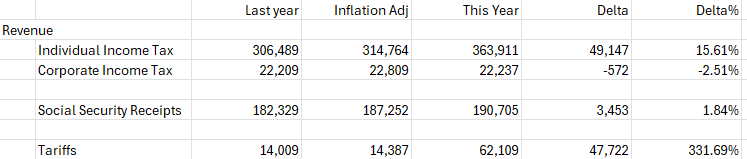
On the Revenue side (just grabbing the interesting bits):
1767197969896.png

Individual Income Taxes are accelerating rapidly (+15.61%), indicating employment growth, small business growth, and productivity gains.

Corporate Taxes are stable to a slight decline (-2.51%), indicating not much. It could be that December is a normal corporate estimated tax day. It is probably noise, but it didn’t go up so…

Tariffs are now providing a meaningful revenue boost.

All in all, this points to a rapidly growing economy where most of the growth is focused toward the individual, the small business community, and hourly productivity. Additionally, based on having only 2.7% inflation, it is apparent that reductions in other expenses offset the tariffs in the main. We have had these tariffs in affect long enough for them to show in the inflation stats – and they really are not.
 
Last edited:
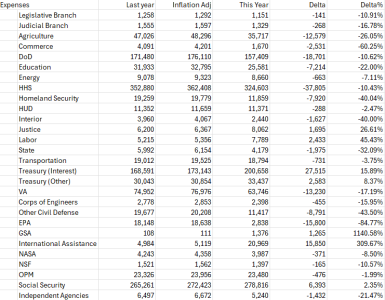
On the Expense side (again, grabbing the interesting deltas):
1767198034441.png

Almost all elements of the Federal Government have seen a meaningful cost cut. This could be noise in that some stuff could be expensed in December that is normally expensed in November. Time will tell. Excepting the massive increase in GSA spending (minimal effect on overall expenditures) and some one off in International Aid, the average cumulative agency expenditure declined by over 16%.

Justice, Labor, and Treasury meaningfully increased spending

EPA, something about other DoD Civil Defense, Interior, Commerce, Agriculture, Education, State, Homeland Security, and Independent Agencies (where USAID used to live among others) all had 20%+ drops in expenditures.

Interest on the debt ballooned by almost 16%, which took a big chunk out of the agency savings.

In the end, one can see through the noise that there is a hand on the tiller. For the first time in my life I can see actual meaningful expenditure reductions. Some of the growing expenditures also likely appear to be temporary.
 
Great stuff Boghie.

Is the GSA increase due to the consolidation of contracting or something else?

I work in the agency and I can attest that we've got about 50% of the staff we did in January and other than the influx of ICE projects, mostly everything else is relatively dead or moving like mollases at best.
Considering this administration wants to get everyone back in the office and sell off buildings and reduce our space portfolio (competing goals), it made very little sense to focus employee reductions on the agency that facilitates the federal space portfolio among the first.

Perhaps it's where doge pulled most of their crap and tried to hide their expenses.
 
@SteelSaving ,

It looks like the culprit is 'Real Property Activities' - which I would bet is the cost of breaking leases and selling assets (The$1,645 Million in the 6th column is what has been spent so far in FY26, the -$12 Million in 9th column was revenue accrued in FY25):

1767207906079.png

If you look at the DOGE website, they did consolidate tons of contracts and outright cancel tons of others. I haven't really data mined the data miners, but I would bet that is where the $296 Million in revenue is coming from.

I think you will find the salaries/expenses for the DOGE team in the 'Executive Office of the President' line item in FY25. It wasn't hidden. However, the 'Monthly Treasury Statement' is a 30k foot look, it doesn't break things down in super fine detail. For FY25, the 'Executive Office of the President' line item costs $500 million, in FY24 it provided revenue of $600 million. DOGE as an entity was disbanded before FY26. However, the Agencies now have DOGE style teams integrated within - they are inside the wire.

It does look like they budgeted an outsized amount for the GSA in FY26. They don't need a big staff and there isn't a large workload in breaking a lease - just sign on the dotted line and pay the break fee.
 
The strange thing is they focused on terminating leases in the soft term when there was no penalty for leaving the lease.

The money earmarked to move agencies into federal buildings would have been planned already, and barring some large projects I'm unaware of, there weren't any. Thanks to congress raiding the federal buildings fund, GSA has basically been requiring agencies to pay for initial space build outs from their own funding for years. It's why you see more lease projects because the private lessors front the money that the agency pays back in rent.

Maybe that extra money is IRA funding. Funny thing is Trump/doge canceled all those contracts (those divisions were RIFfed as well) and I don't know what happened to the money. Apparently it was spent but I couldn't tell you on what.
 
Back
Top