CallMeIshmael
First Allocation
- Reaction score
- 0
Comment on today's Latest Market Commentary
What was that?
Before we get to conspiracies, which may or may not be true, consider some of the technical indicators that show we’re in for a correction.
First is the MACD, or, almost the same thing on the S&P 500 chart in today's commentary, the PMO. The divergence between the height of its peaks and the peaks in prices is significant. Though prices got higher April 2 than the previous peak Mar. 6-7, the PMO was lower. This is a sign of weakness. Look at the two peaks Dec. 31 and Jan 15-22 – you see the same divergence, followed by the correction starting Jan. 23. This pattern applies to all the major indices. In the case of NASDAQ and QQQ, which been reaching lower highs the past two weeks, the falls in MACD are markedly lower than the falls in price. Like all technical indicators, this is not fool-proof, but it’s one thing to consider.
Second, the NASDAQ (both as a whole and the 100 leaders in QQQ or NDX) has been underperforming the broader market the past couple weeks. Is it the leader? If so, it flashed a couple warning signs recently that it was leading downward. It failed to stay even with the S&P and Dow March 21 and 24 (Friday and Monday). Again, it failed to reach a new high when the S&P (and Transportations) did on April 2-3. In fact, it showed two successively lower peaks since its last high.
Finally, the so-so volume on the apparent breakouts in the S&P in Transportations didn’t manifest any underlying excitement, making a real breakout seem unlikely.
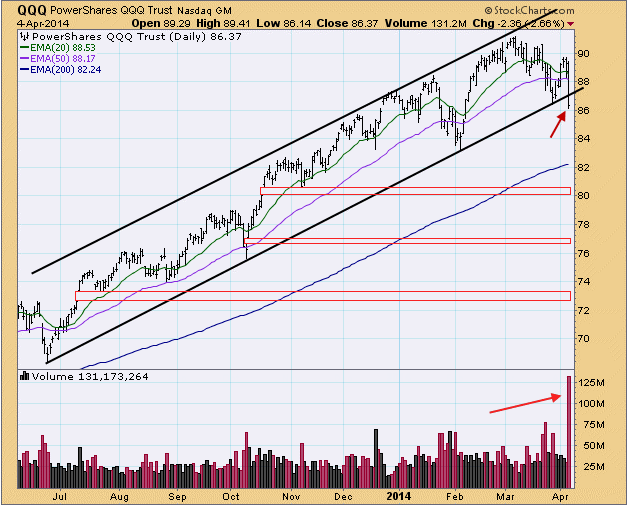
This correction is coming sooner than we’re used to after the last one in January. I’d hope this is another short-term thing like January’s, and the NASDAQ chart alone might suggest we’re near the bottom. (Friday’s low is more or less in line with its year-long rising trend) But when I think of it as the leader and compare it to S&P 500, with prices still way up there where they were in early March, I feel a little more cautious, and think this correction will go a little deeper.
[FONT="]As a side issue, I’ve put most of my TSP into the F-fund now because I see it forming a big old cup-and-handle base since late October. Maybe it’ll break out during this cycle up, or maybe the next one. But even if it goes back down to the bottom of its present channel, that’s less than 1%, not very risky.[/FONT]
What was that?
Before we get to conspiracies, which may or may not be true, consider some of the technical indicators that show we’re in for a correction.
First is the MACD, or, almost the same thing on the S&P 500 chart in today's commentary, the PMO. The divergence between the height of its peaks and the peaks in prices is significant. Though prices got higher April 2 than the previous peak Mar. 6-7, the PMO was lower. This is a sign of weakness. Look at the two peaks Dec. 31 and Jan 15-22 – you see the same divergence, followed by the correction starting Jan. 23. This pattern applies to all the major indices. In the case of NASDAQ and QQQ, which been reaching lower highs the past two weeks, the falls in MACD are markedly lower than the falls in price. Like all technical indicators, this is not fool-proof, but it’s one thing to consider.
Second, the NASDAQ (both as a whole and the 100 leaders in QQQ or NDX) has been underperforming the broader market the past couple weeks. Is it the leader? If so, it flashed a couple warning signs recently that it was leading downward. It failed to stay even with the S&P and Dow March 21 and 24 (Friday and Monday). Again, it failed to reach a new high when the S&P (and Transportations) did on April 2-3. In fact, it showed two successively lower peaks since its last high.
Finally, the so-so volume on the apparent breakouts in the S&P in Transportations didn’t manifest any underlying excitement, making a real breakout seem unlikely.
This correction is coming sooner than we’re used to after the last one in January. I’d hope this is another short-term thing like January’s, and the NASDAQ chart alone might suggest we’re near the bottom. (Friday’s low is more or less in line with its year-long rising trend) But when I think of it as the leader and compare it to S&P 500, with prices still way up there where they were in early March, I feel a little more cautious, and think this correction will go a little deeper.
[FONT="]As a side issue, I’ve put most of my TSP into the F-fund now because I see it forming a big old cup-and-handle base since late October. Maybe it’ll break out during this cycle up, or maybe the next one. But even if it goes back down to the bottom of its present channel, that’s less than 1%, not very risky.[/FONT]