
As outlined in the Stock Trader's Almanac, the January Trifecta consists of using three time frames as a seasonal indicator for the performance of the year. Simply put, when all three time frames are positive, the year tends to close positive and the gains tend to be stronger.
The first timeframe is the Santa Claus Rally (last 5 days of December & first 2 of January). The second is the first 5 days of January, and the third is the Month of January. For this blog, I’ll use the data I already have on file, and pick years I consistently use to measure statistics.
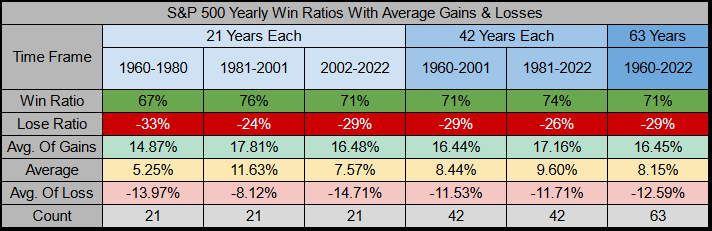
First I'd like to establish the normal baseline. The chart below shows us three 21-year, two 42-year and one 63-year timeframe. Our yearly win ratio ranges from 67% to 71% with the average return of 8.15% across 63 years.
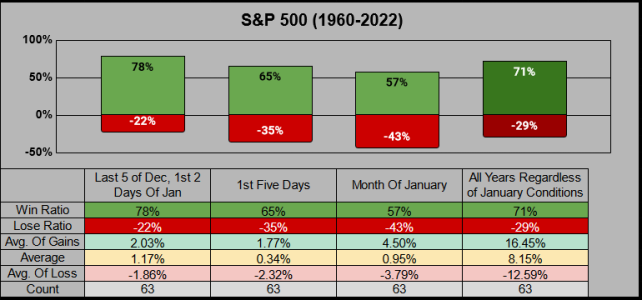
To start us off, here are the win ratios for all three indicators compared with the baseline 63 years (the January Trifecta is not applied here). The 1st column looks great with a 78% Win Ratio (for those 7-days), as so does the 2nd Column with a 65% win ratio over 5-days. Lastly, the Month of January looks normal with 57%.
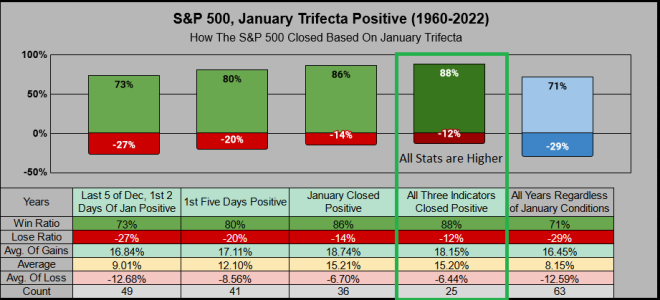
Now let's see what happens for the year when all three of the January indicators closed up. The 5th Column is our normal baseline.
Columns 1-3: If any of the three indicators closed positive (independently), the end of year results were better than the 5th column’s baseline results.
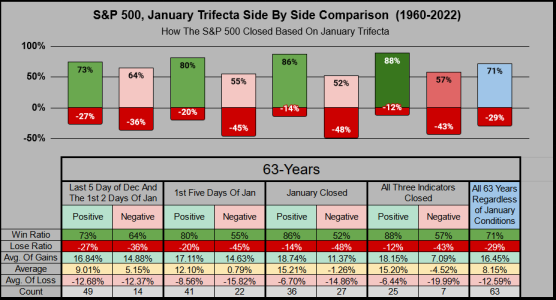
Fourth Column: When all three indicators closed up, the Yearly win ratio jumps from 71% to 88%, the Average-of-gains is higher, the average is higher, and the average-of-losses is lower. Here’s the caveat, column 4 has only occurred 25 times in 63 years. So with slightly limited data, we’ll need to look for further confirmation of this seasonal trend.
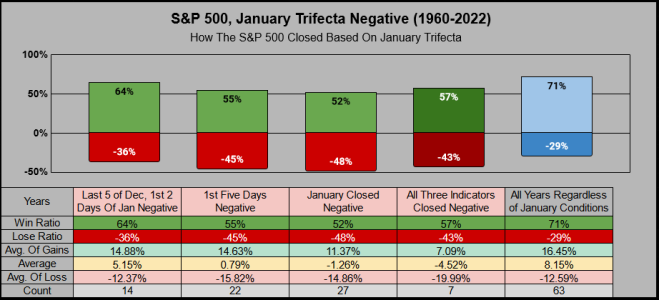
The chart below shows us when all three indicators close down, the yearly win ratio drops from 71% to 57%, the gains are lower and the losses are higher, but this has only happened 7 times so once again the data is limited. However, if we look at the third indicator we can see it has closed down 27 times resulting in a 52% yearly win ratio. Also the 2nd indicator has closed down 22 times giving us a 55% win ratio.
The most striking observation, when any of the three (or all three) indicators close down almost every condition is worse than the original baseline. The only exception was the first column's average-of-loses at -12.37%, (aside from this lone stat) all win ratios and returns were worse.
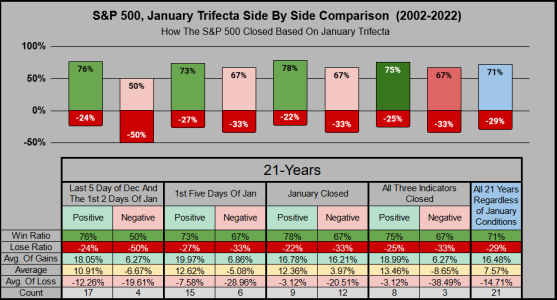
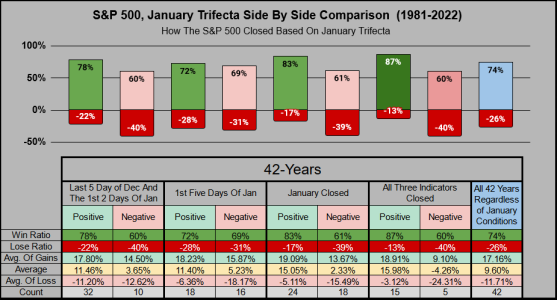
I’ll finalize this with 3 charts on the 21/42/63 year timeframe, showing both positive and negative results side-by-side. The results are pretty good, and although in some cases the data can be limited, the overall theme is very consistent. When the three timeframes closed positive, the end of year results were promising.
Thanks for reading, have a great year.

