The Great Annuity Rip-Off

GarySpicuzza

Visitor
Reaction score
1
Kiplinger - Timely - Trusted - Personal Financial Advice

I've found Kiplinger to be the largest collection of financial clueless clowns on the Internet.

THIS article titled The Great Annuity Rip-Off written by Kimberly Lankford is a prime example of just how utterly ignorant Kiplinger is on the topic of annuities in general and FIXED annuities in particular.

What's worse is the fact they allow absolutely false, misleading and inaccurate information to remain on their site.

Let's have some fun with Ms. Lankford by pitting her words against actual fixed annuity contract provisions.

We need to go no further than her opening remarks.
Kimberly Lankford wrote:
Seven years ago, when Alice Bouchard was 85 and needed her money to be easily accessible, an insurance agent sold her a deferred annuity that tied up her money until she was 101. If she had needed to withdraw the money during the first five years after buying the annuity, she would have paid a massive 25% surrender charge.

Now I don't doubt the un-named annuity product had an "ANNUITY DATE" set for 16 years in the future and IF the un-named annuity product did in fact have a 25% surrender charge during the first 5 contract years it would have been because it paid an UP-FRONT interest bonus in the neighborhood of 10% perhaps for ALL new premium going into the contract during the first 5 years. We will never know since she doesn't say which insurance company product she's referencing.

Attorneys, News Media, Stock Brokers and Bankers simply cannot seem to comprehend the plain English meaning of Annuity Contract terminology.

Seniors over age 70 who buy the vast majority of annuities nationwide have no problem understanding:

The Annuity Date printed on the Contract Data page or the Surrender Charge schedule CLEARLY written in BOLD print on the Contract Data page or the plain English terms of the 10% FREE Withdrawal provision. Please click on the links to see these as they actually appear in most ALL fixed annuity contracts.

On the Contract Data page of a case I just wrote it shows the Annuitant's age 79 and an Annuity Date of 05/16/2034. She will be 105 years old on the Annuity Date.

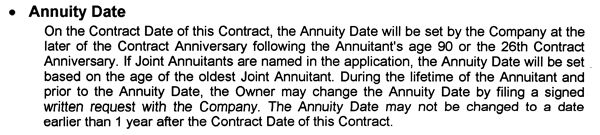
But what does the Annuity Date mean and can it be changed?

The Annuity Date is the maximum date in the future the Annuitant can hold the contract in tax deferral. On the Annuity one MUST elect a settlement OPTION. The Owner/Annuitant can CHANGE the Annuity Date to ANY date after the first contract year.

So when this clueless clown Kimberly Lankford writes:
"...an insurance agent sold her a deferred annuity that tied up her money until she was 101."

She's referring to the Annuity Date printed on the Contract Data page without an elementary understanding of what that term means in the contract and she either conveniently doesn't inform her reader's the Annuity Date can be changed or simply doesn't know the subject matter on which she's writing about.

Moving on to her next half truth, by the way, a half truth is a lie, also known as, a material misrepresentation:
If she had needed to withdraw the money during the first five years after buying the annuity, she would have paid a massive 25% surrender charge.

Hmmmm, this gives the reader the impression that ANY money withdrawn during the first 5 years would incur "a massive 25% surrender charge."

Really? What about the 10% FREE Withdrawal provision. Did you forget about that Kimberly or do you just not know or are you purposely misrepresenting yourself again?

A person would have to go out of their way and do extraordinary research to find ANY annuity product sold by any Insurance Company that DOES NOT have a 10% FREE Withdrawal provision.

Please review the actual fixed annuity contract provisions below.

Please read Ms. Kimberly Lankford's article in its entirety.

Then please post your questions about any of her absurd blanket condemnations regarding an entire insurance product line of which over $200 billion dollars are invested in each and every year and I will be happy to respond.

The Contract Data page:
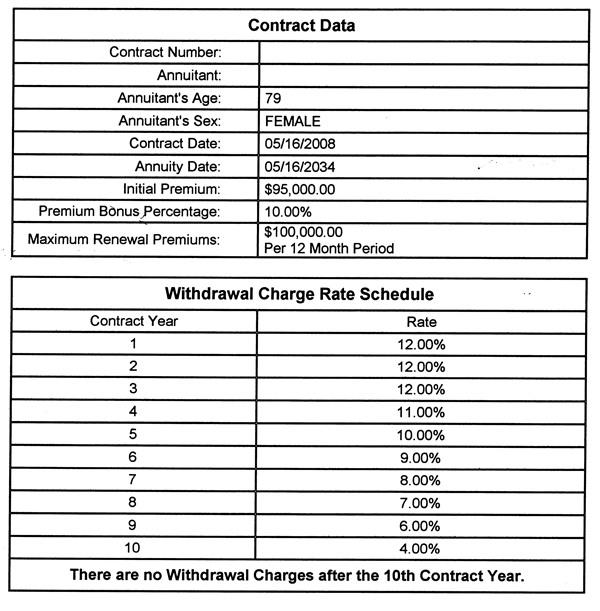
ContractData.jpg


The Annuity Date clause:
AnnuityDate.jpg


The 10% Free Withdraw provision:
FreeWithdrawal.jpg
 
Yes, I have been selling Fixed Annuities, Life Insurance, Disability Income, Medical Insurance and Long Term Care Insurance since 1985 along with comprehensive Estate Planning and the funding of Irrevocable Life Insurance Trusts with Second-to-Die policies.

Thank you for asking.

Did you have a question regarding something written in THIS article you would like for me to answer?

By the way, click HERE to read exactly correct information from Charles Schwab.

Looking for a retirement savings vehicle offering you higher earnings if the market goes up, yet guaranteed growth even if it doesn't? An equity index annuity from Schwab may be the answer. Index annuities let you participate in the potential growth of an equity index while protecting your savings with minimum guaranteed earnings. This makes them ideal for people who want to participate in the market performance upside without exposing their retirement savings to downside risk.

How do index annuities work?
You purchase an index annuity contract with a single premium payment. Earnings are linked to a formula based on changes in select equity indexes. If the index goes up, you share in the gains, up to the annual interest rate cap. If the market goes down, you're protected—your principal and credited interest can never decrease due to market declines.

Get the best of both worlds.
Index annuities are appealing because like traditional fixed annuities, your principal and credited interest can never decrease due to market declines, with all interest tax-deferred until you make withdrawals. However, index annuities also offer the opportunity for higher returns than many bank or traditional fixed rate vehicles by linking the interest rate to certain equity indexes. Then, when it's time to receive a payout, you can choose from a variety of options to set up a reliable stream of retirement income.

For clients looking to benefit from the performance of leading market indexes while guaranteeing principal protection plus minimum growth, Schwab offers a five-year and a ten-year contract. Choose either the S&P 500® or the Dow Jones Industrial AverageSM as your benchmark.
 
ChemEng, this thread is about THIS article titled The Great Annuity Rip-Off written by Kimberly Lankford and how it's a prime example of just how utterly ignorant Kiplinger is on the topic of annuities in general and FIXED annuities in particular.

Did you have a question regarding something written in THIS article you would like for me to answer?
 
A fitting post within such a descriptive thread title.
Thanks Gary! Sharing what you know is appreciated.

Now, if I could only find the time to read the damn things (LoL). :nuts:
 
You answered the questions you posed in your article thanks to your double speak.

Really? What about the 10% FREE Withdrawal provision. Did you forget about that Kimberly or do you just not know or are you purposely misrepresenting yourself again?
as they actually appear in most ALL fixed annuity contracts.

"Most all" is not the same thing as "all." Therefore, it is likely she could have been writing about a fixed annuity, that you admit exists, that does not have the 10% redemption clause.

Some more questions:
1. Why didn't you disclose your financial interest about fixed annuities in your initial post?
2. What motivation would Kiplinger's have to misrepresent fixed annuities? On the other hand, what motivation would you have to attack their article?
3. If your position is different and valid, why don't you write up an article as a rebuttal. I'm sure Kiplingers would entertain reviewing it.

As it is, your comments sound very similar in tenor to the UFF/MMA scams that are posted on other various finance boards. So I am inclined not to give them much credence above a person simply trying to make a paycheck.
 
ChemEng wrote:
"Most all" is not the same thing as "all." Therefore, it is likely she could have been writing about a fixed annuity, that you admit exists, that does not have the 10% redemption clause.
The 10% Free Withdraw provision is a standard contract provision on virtually ALL annuities. I know of no fixed annuity with any company that DOES NOT have a 10% free withdraw provision.

ChemEng the rest of your questions have nothing to with annuity contract provisions much like Ms. Lankford's article doesn't say anything about actual contract provisions and benefits.

Now if you would please take the time to read her article in its entirety and please quote something she wrote I'd be happy to reply.

Please don't make this thread about me personally.

I want the annuity buying public to have the EXACTLY CORRECT information so they can make an informed decision.

I'll ask again just to hammer home the point, READ Kimberly Lankford's article then please copy and paste some outrage regarding an ACTUAL policy provision and I'll reply.
 
The 10% Free Withdraw provision is a standard contract provision on virtually ALL annuities.
More double talk--"virtually all" is not the same as "all." Until you can reconcile your language with your intent, then it is possible that she is referring to one of those annuities that does not include that language.
 
ChemEng,

Please tell me the Insurance Company name and the specific product Ms. Lankford is talking about? Without THAT information she may as well be making up the whole story.

There isn't an annuity contract written that DOES NOT have a free withdrawal provision.

None.
Nada.
Zero.
Not ONE.

10% is the typical MINIMUM, some contracts allow 10% per year but if no withdraws are taken up to 50% cummulative or 20% every other year if no withdraws were taken in the previous year.

Annuity threads are always so much fun because setting aside the Surrender Charge schedule nobody can EVER come up with another negative feature.

ChemEng, tell me something, "OTHER" than the Surrender Charge schedule, what's the "other" negative feature in a FIXED annuity contract.
 
ChemEng, tell me something, "OTHER" than the Surrender Charge schedule, what's the "other" negative feature in a FIXED annuity contract.
You are the sale person for these products and you want me to tell you what the negative is? Alrighty then...

That aside, Ill bite. The obvious negative feature for fixed annuities (and any other annuity for that matter) is reduced value for years that markets exceed the fixed return rate. Another negative is the increased cost for the product when compared to other similar products (VPGFX, VPGDX, and VPDFX for example) that are MUCH cheaper.
 
ChemEng wrote:
The obvious negative feature for fixed annuities (and any other annuity for that matter) is reduced value for years that markets exceed the fixed return rate.

Traditional Fixed Annuities and Fixed Indexed Annuities ARE NOT INVESTMENTS. They are safe money savings instruments much like a bank CD in that respect. To compare money saved in a fixed annuity with money invested in stocks and mutual funds is apples and oranges.

Allow me to re-write your statement to make my point and let's see if anyone would ever write or compare or say the following:

The obvious negative feature for bank CDs (and any other CD for that matter) is reduced value for years that markets exceed the fixed return rate.

The obvious negative feature for Treasury Bonds (and any other bond for that matter) is reduced value for years that markets exceed the fixed return rate.

The obvious negative feature for bank savings accounts (and any other savings for that matter) is reduced value for years that markets exceed the fixed return rate.

Get my point?

By the way, you didn't point out the "other" negative feature in a fixed annuity (aside from the Surrender Charge schedule), you simply compared a SAFE money savings instrument to at risk investment money.

Another negative is the increased cost for the product when compared to other similar products (VPGFX, VPGDX, and VPDFX for example) that are MUCH cheaper.

There is ZERO costs in a FIXED ANNUITY.
In dollars and cents that would be written $0.00.

What has been confused here are costs in VARIABLE ANNUITIES (about 3% per year) with FIXED annuities (0% per year) then compared the non-comparables with mutual funds or stocks.

A Variable Annuity is a bloated pig with lip stick SOLD by the Series 7 Registered Representative crowd who HAD to obtain an insurance license to be able to sell that product. They are the classic day traders playing stocks like a flea market swap meet....with your money.

It is imperative that one understands that point.

Insurance agents DO NOT sell Variable Annuities because they violate they fundamental aspect of "Safety of Principal" inherent in ALL annuities EXCEPT VARIABLE annuities.

Now, what's the "other" negative feature in a fixed annuity setting aside the surrender charge schedule?

Perhaps, before you answer, you may want to read THIS thread titled A Reporter's Guide to Fixed Annuities
 
I don't believe you will find much success marketing your annuities here. TSP already offers this stuff, and only 1-2% use it. Typically, annuities don't outperform other investment instruments that offer similar if not superior returns and stability. Annuities are another form of insurance, with costly premiums. Bonds, CDs and even savings accounts can produce similar results.

And, for the Fed employee, the G fund pays approximately as well as annuities without the obligations or restrictions. An annuity that provides greater returns will likely be offered to those who will have less time to collect. Annuities do cost, and have a high cost, though those who sell them are adept at confusing and hiding the expenses. This is roughly equivalent to trying to get someone to by Whole or Universal life insurance.

Those who offer annuities do so in hopes that the annuant will never be able to collect a sufficient return so that themselves, may be able retain the principle and the majority of interest earned. Annuities are very expensive income insurance, which is good for the insurance companies but not the annuant.

Before you present material on this board, you should do your homework, understand your audience and the resources already available to them and then determine if your product or service has any value or merit.

And then, you should contact the board Administrator and arrange to remit compensation for your commercial.

However, I suspect your thread has less to do with a desire to "inform" the public than to "sell" to the public.

So, you will soon understand the time you spend trying to convince us of the superior nature of your "product" will likely be a distraction from selling to others who are less informed. Unless you aren't that busy and have the time to devote to this. Then I suppose that tells us much about the state of the "annuity" business.

I challenge you to remove the link and information to your website if your motives are truly alturistic.

If you are really interested in informing the public, I am sure you will support and encourage those intersted to visit the following link http://www.fool.com/retirement/annuities/annuities.htm for an unbiased review of annuities.
 
Is Gothem being hood-winked ?
Are there alternative goals at work ?
Will Catwoman get her claws into Batman ?
Will Robin ever come out of the closet ?

Stay Tuned Till Next Entry !
Same Bat-Time - Same Bat-Thread !
:nuts:
 
GarySpicuzza;165931 There is ZERO costs in a [B said:
FIXED[/B] ANNUITY.
In dollars and cents that would be written $0.00.

Fees and Expenses For FIXED ANNUITIES
Most fees and expenses of a fixed annuity are factored into the stated annual percentage rate the investor is quoted. The rate quoted is the rate paid. Fixed annuity fees and expenses generally cover the insurance company's administrative expenses, the cost of offering the annuitization guarantee and profits to the insurance company and sales agent. Some fixed annuities may assess an annual contract fee, typically around $30.


http://www.edwardjones.com/cgi/getHTML.cgi?page=/USA/products/investments/annuities_fixed.html
 
There isn't an annuity contract written that DOES NOT have a free withdrawal provision.

None.
Nada.
Zero.
Not ONE.

10% is the typical MINIMUM, some contracts allow 10% per year but if no withdraws are taken up to 50% cummulative or 20% every other year if no withdraws were taken in the previous year.

Annuity threads are always so much fun because setting aside the Surrender Charge schedule nobody can EVER come up with another negative feature.

An Escape Clause
Some fixed annuities have a bailout clause, sometimes known as an escape clause, that allows you to surrender your policy without penalty if the interest rate that’s being offered drops below a certain level, often one percentage point less than the previous rate, even if it’s above the guaranteed rate.
However, if an annuity's rate drops significantly, it usually means interest rates in general have dropped; and newly issued fixed annuities are likely to be paying at comparable rates to the one you’re giving up.
And if you transfer your money to a different type of investment or keep the cash, and you’re younger than 59½, you will probably have to pay a 10% premature withdrawal penalty on the amount of taxable earnings you surrender, plus whatever taxes are due on your earnings. If you withdraw only part of the accumulated contract value, the federal government considers that you take earnings first, leaving the principal in the contract. That means you could pay tax on the entire withdrawal amount.
http://www.annuity-strategies.com/fixed_annuities.html
 
Back
Top